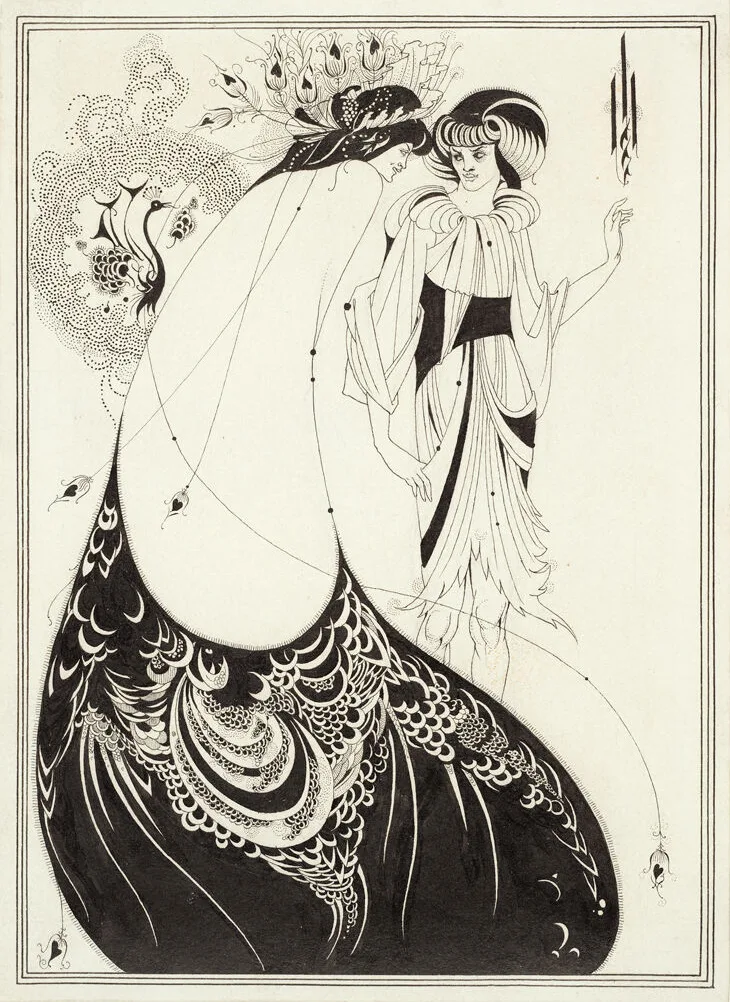
Hình ảnh cùng thời.Aubrey Beardsley, “The Peacock Skirt”, 1894. Tranh vẽ cho vở Salome của Wilde, cùng năm với các bài thơ văn xuôi này; không phải minh họa cho văn bản.Aubrey Beardsley, 1894, “The Peacock Skirt”, drawing for Wilde’s Salome (Harvard Art Museums). Public domain (artist died 1898). Wikimedia Commons. Nguồn
Một nhà điêu khắc muốn đúc niềm vui thoáng qua thành tượng đồng, và vấp phải một bài toán về chất liệu.
Một nghệ sĩ muốn tạc hình “Niềm Vui chỉ ở lại trong chốc lát”. Oscar Wilde chỉ cần vài dòng để biến chuyện ấy thành một ngụ ngôn về cái giá của nghệ thuật. Đây là một trong sáu bài thơ văn xuôi ông cho đăng năm 1894.
Original English · 1913 Methuen edition (Project Gutenberg #774)
Oscar Wilde, “The Artist,” Poems in Prose (Fortnightly Review, July 1894); in Essays and Lectures, 4th ed., Methuen & Co. Ltd., 1913, pp. 227–228. Digital transcription: David Price, Project Gutenberg #774.
Five complete paragraphs rechecked against the identified Gutenberg reproduction on 2026-11-01: exact match after HTML/whitespace normalization, plus AI-assisted passage comparison. This technical source check does not assert human peer review or a certified critical edition.
Oscar Wilde died in 1900; 'The Artist' appeared in 1894 and the selected print witness is from 1913. Assessed public domain: USA (pre-1931), EU (usually life plus 70) and Vietnam (ordinary literary works, life plus 50 under Article 27). Moral rights and variant editions must still be respected. Not a global legal guarantee.
Oscar Wilde, “The Artist,” Poems in Prose (Fortnightly Review, July 1894); in Essays and Lectures, 4th ed., Methuen & Co. Ltd., 1913, pp. 227–228. Digital transcription: David Price, Project Gutenberg #774.
Tùy chọn. Vị trí đọc được lưu trong trình duyệt trên thiết bị này; không cần tài khoản.
Các đoạn văn · 5
One evening there came into his soul the desire to fashion an image of The Pleasure that abideth for a Moment. And he went forth into the world to look for bronze. For he could think only in bronze.
But all the bronze of the whole world had disappeared, nor anywhere in the whole world was there any bronze to be found, save only the bronze of the image of The Sorrow that endureth for Ever.
Now this image he had himself, and with his own hands, fashioned, and had set it on the tomb of the one thing he had loved in life. On the tomb of the dead thing he had most loved had he set this image of his own fashioning, that it might serve as a sign of the love of man that dieth not, and a symbol of the sorrow of man that endureth for ever. And in the whole world there was no other bronze save the bronze of this image.