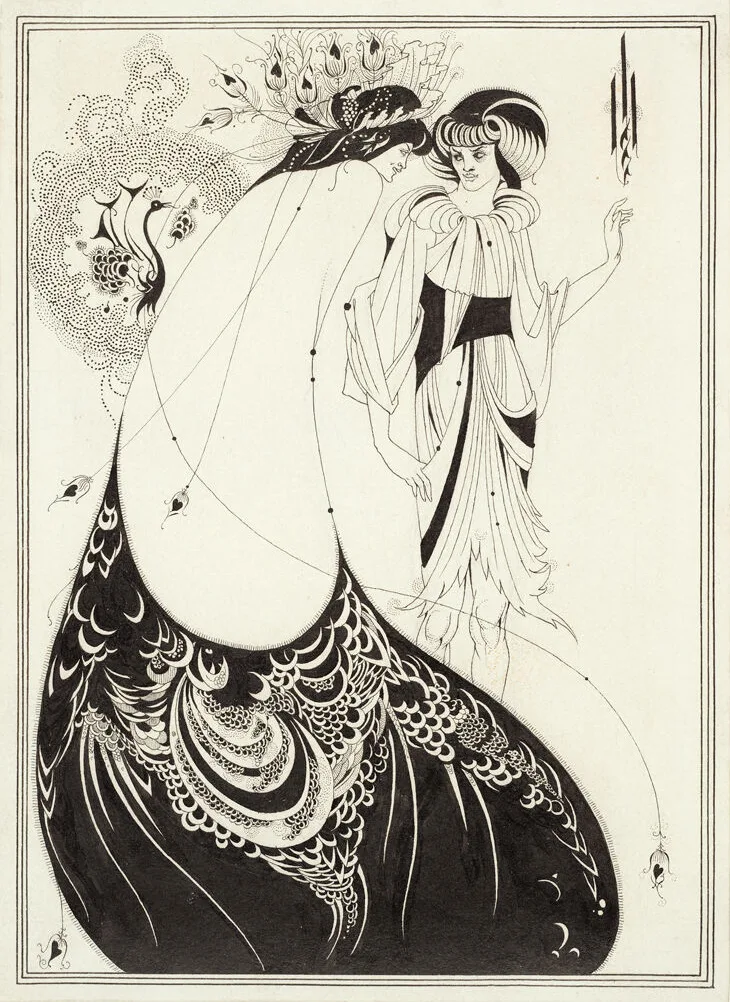
Black-and-white ink drawing of a woman in a vast peacock-feather gown beside a slender figure, in Art Nouveau line.
Imagen de época. Aubrey Beardsley, “The Peacock Skirt”, 1894. A drawing for Wilde’s play Salome, from the same year as these prose poems; it does not illustrate this text.Aubrey Beardsley, 1894, “The Peacock Skirt”, drawing for Wilde’s Salome (Harvard Art Museums). Public domain (artist died 1898). Wikimedia Commons. Fuente

Oscar Wilde · English · ≈ 1 min de lectura

The Artist

Un escultor se propone dar cuerpo en bronce a un placer fugaz, y se topa con un problema de materiales.

Un artista quiere hacer una imagen del «Placer que permanece un instante». A Oscar Wilde le bastaron unas pocas líneas para convertir ese encargo en una parábola sobre lo que cuesta el arte. Es uno de los seis poemas en prosa que publicó en 1894.

Original English · 1913 Methuen edition (Project Gutenberg #774)

Edición: English

Texto original cotejado con la fuente citada. No es una edición crítica certificada de forma independiente.

Fuente del texto

Pasajes · 5

One evening there came into his soul the desire to fashion an image of The Pleasure that abideth for a Moment. And he went forth into the world to look for bronze. For he could think only in bronze.

But all the bronze of the whole world had disappeared, nor anywhere in the whole world was there any bronze to be found, save only the bronze of the image of The Sorrow that endureth for Ever.

Now this image he had himself, and with his own hands, fashioned, and had set it on the tomb of the one thing he had loved in life. On the tomb of the dead thing he had most loved had he set this image of his own fashioning, that it might serve as a sign of the love of man that dieth not, and a symbol of the sorrow of man that endureth for ever. And in the whole world there was no other bronze save the bronze of this image.

And he took the image he had fashioned, and set it in a great furnace, and gave it to the fire.

And out of the bronze of the image of The Sorrow that endureth for Ever he fashioned an image of The Pleasure that abideth for a Moment.