
The Fall of the House of Usher
English
The Fall of the House of Usher · English, The Works of Edgar Allan Poe, Raven Edition, vol. 2
LireEdgar Allan Poe · 1839
Un voyageur répond à l’appel d’un ami et gagne une demeure au bord d’un étang noir, où une famille et ses murs semblent partager un même mal.
Un narrateur sans nom rend visite à son ami d’enfance Roderick Usher, malade de corps et d’esprit, qui vit avec sa sœur Madeline dans une demeure ancestrale en ruine. Paru pour la première fois dans Burton’s Gentleman’s Magazine en septembre 1839, c’est le conte gothique le plus connu de Poe et l’une des entrées les plus courtes dans sa façon de bâtir la peur.
Aucune traduction publiée dans la langue de cette interface. Vous pouvez lire l’original ou une autre édition disponible.
Lire · English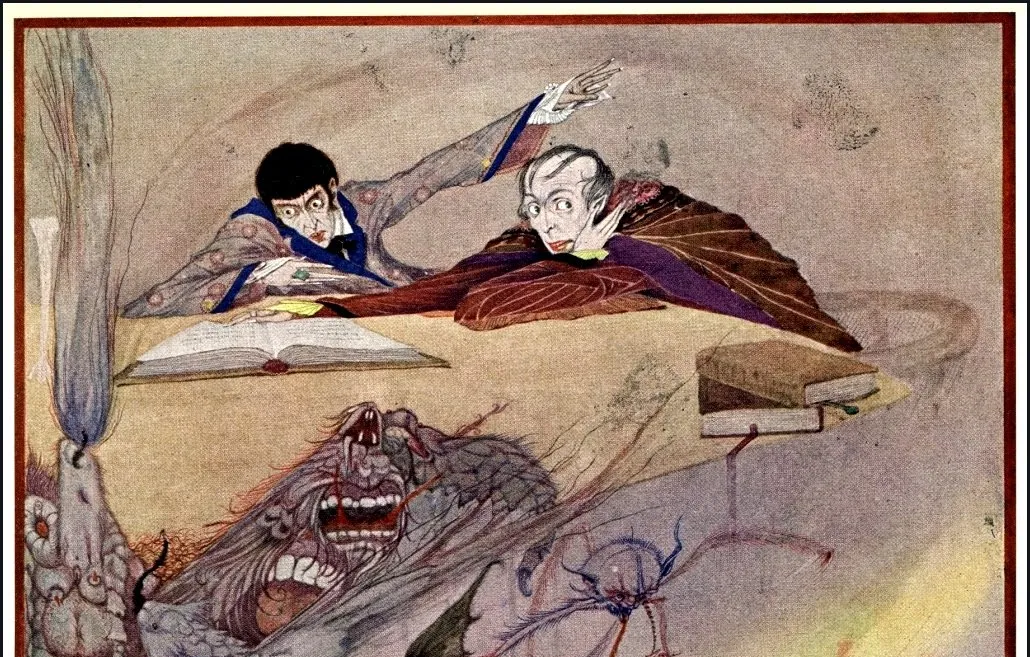
The Fall of the House of Usher is a short Gothic tale told by a visitor who cannot say why a house fills him with dread. Poe gives him a damp, cracked building, an old family, a friend whose nerves have become unbearably sharp, and almost nothing else. The effect is the point: It has been called the best example of Poe’s “totality”, in which every element is related to every other. That economy is why it still works. Fear here comes from perception itself, from a mind that cannot trust its senses, and from the suspicion that a family’s illness and its house have grown into one thing.
Poe did not invent the haunted house, and critics link the story to E. T. A. Hoffmann’s “Das Majorat” and Horace Walpole’s The Castle of Otranto. What he did was compress it. Washington Irving wrote to Poe that he had “laid on too much colouring” but was “erring on the best side”. The tale was revised for Tales of the Grotesque and Arabesque in 1840 and has kept generating other art: Claude Debussy worked on an opera of it from 1908 to 1917, Jean Epstein filmed it in 1928, Roger Corman’s 1960 film began his eight Poe pictures, and Ray Bradbury answered it with “Usher II” in 1950. Harry Clarke’s Poe illustrations (Harrap, 1919; enlarged 1923) are among its best-known visual companions.
While you read, track how the narrator describes the house as if it had a face, and how his own mood starts to follow what he sees. Notice the pieces Poe lets into the house: a book, a painting, a ballad Roderick sings or recites, a library that seems chosen to feed a mind already turned in on itself. Each one repeats the main note in a different key. The story is short enough to read aloud in an evening, which suits it; its reputation rests as much on rhythm and sound as on plot.
Présentation rédigée pour LitMundi avec l’aide de l’IA et vérifiée d’après les sources ci-dessous.
La disponibilité des traductions reste à étudier. Un brouillon ne prouve pas l’absence d’une traduction.
← Retour à la collection