
The Fall of the House of Usher
English
The Fall of the House of Usher · English, The Works of Edgar Allan Poe, Raven Edition, vol. 2
LeerEdgar Allan Poe · 1839
Un viajero acude al ruego de un amigo y llega a una casa junto a un lago negro, donde una familia y sus muros parecen compartir una misma enfermedad.
Un narrador sin nombre visita a su amigo de la infancia Roderick Usher, enfermo de cuerpo y de mente, que vive con su hermana Madeline en una casa ancestral en ruinas. Publicado por primera vez en Burton’s Gentleman’s Magazine en septiembre de 1839, es el cuento gótico más conocido de Poe y una de las vías más breves para entrar en su manera de construir el miedo.
No hay una traducción publicada en el idioma de esta interfaz. Puedes leer el original u otra edición disponible.
Leer · English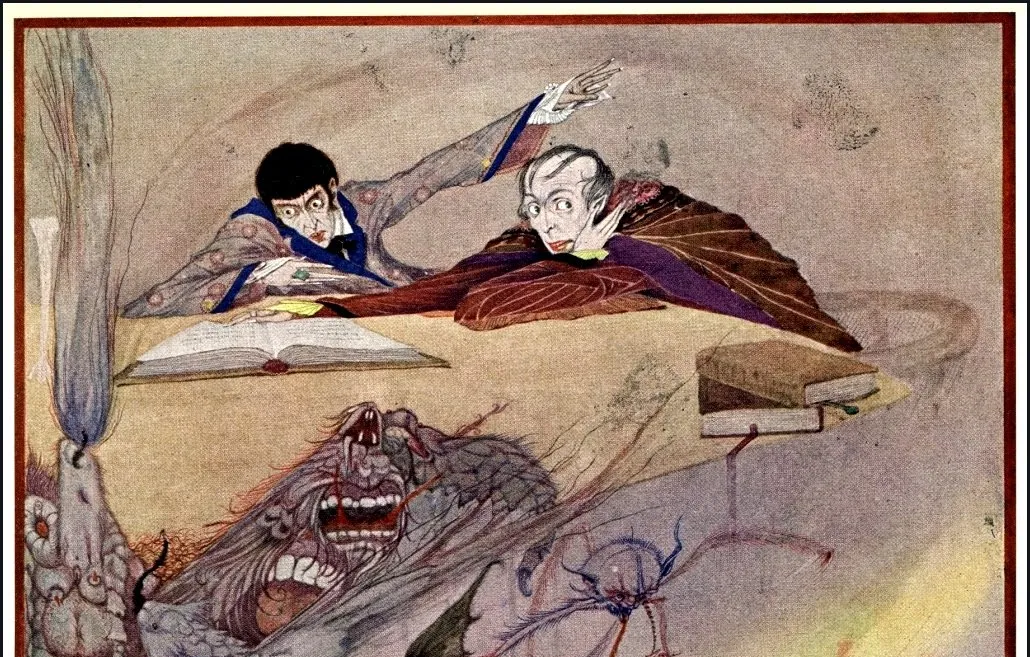
The Fall of the House of Usher is a short Gothic tale told by a visitor who cannot say why a house fills him with dread. Poe gives him a damp, cracked building, an old family, a friend whose nerves have become unbearably sharp, and almost nothing else. The effect is the point: It has been called the best example of Poe’s “totality”, in which every element is related to every other. That economy is why it still works. Fear here comes from perception itself, from a mind that cannot trust its senses, and from the suspicion that a family’s illness and its house have grown into one thing.
Poe did not invent the haunted house, and critics link the story to E. T. A. Hoffmann’s “Das Majorat” and Horace Walpole’s The Castle of Otranto. What he did was compress it. Washington Irving wrote to Poe that he had “laid on too much colouring” but was “erring on the best side”. The tale was revised for Tales of the Grotesque and Arabesque in 1840 and has kept generating other art: Claude Debussy worked on an opera of it from 1908 to 1917, Jean Epstein filmed it in 1928, Roger Corman’s 1960 film began his eight Poe pictures, and Ray Bradbury answered it with “Usher II” in 1950. Harry Clarke’s Poe illustrations (Harrap, 1919; enlarged 1923) are among its best-known visual companions.
While you read, track how the narrator describes the house as if it had a face, and how his own mood starts to follow what he sees. Notice the pieces Poe lets into the house: a book, a painting, a ballad Roderick sings or recites, a library that seems chosen to feed a mind already turned in on itself. Each one repeats the main note in a different key. The story is short enough to read aloud in an evening, which suits it; its reputation rests as much on rhythm and sound as on plot.
Introducción redactada para LitMundi con ayuda de IA y contrastada con las fuentes que se indican abajo.
La disponibilidad de traducciones sigue en estudio. Un borrador no demuestra que no exista una traducción.
← Volver a la colección