
A Christmas Carol
English
A Christmas Carol · English, Chapman & Hall 1843
LireCharles Dickens · 1843
Un avare, un associé mort et trois esprits : l’histoire de fantômes que Dickens écrivit en six semaines pour Noël 1843.
La veille de Noël, Ebenezer Scrooge, prêteur londonien qui déteste la fête, reçoit la visite du fantôme de son associé défunt, Jacob Marley. Le fantôme apporte un avertissement et trois visiteurs qui montreront à Scrooge sa propre vie.
Aucune traduction publiée dans la langue de cette interface. Vous pouvez lire l’original ou une autre édition disponible.
Lire · English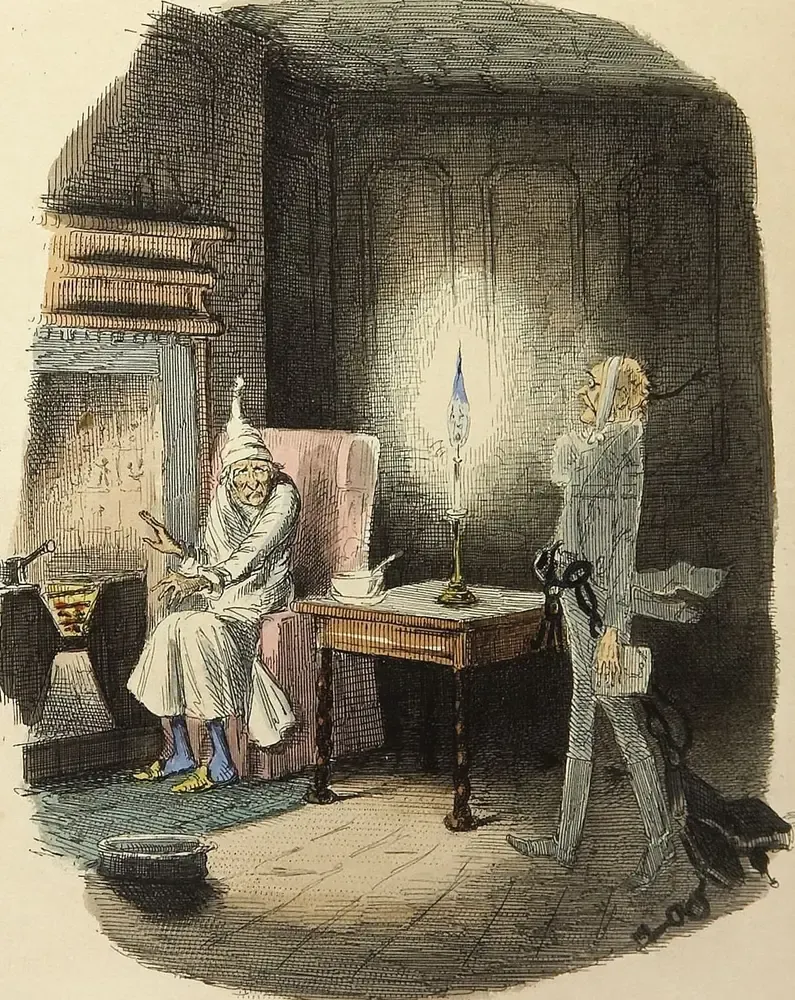
A Christmas Carol is short, fast and built like a ghost story: a cold counting-house, a warning, a night of visions. Its life comes from Dickens’s voice. He addresses the reader directly, jokes, describes food and weather with relish, and then drops into plain, hard fact about poverty. Nearly everyone knows the plot, and yet the book is better than its reputation, because the prose is funnier and angrier than the adaptations. It is a Christmas story that spends as much time on want and ignorance as on warmth.
Dickens began it in October 1843 and finished the last pages in early December, under financial pressure as Martin Chuzzlewit sold poorly. He was moved by child labour in the Cornish tin mines and by a visit to the Field Lane Ragged School. Published on 19 December 1843 by Chapman & Hall with John Leech’s illustrations, four hand-coloured etchings and four woodcuts, the first print run of 6,000 copies sold out by Christmas Eve and thirteen editions had appeared by the end of 1844. Stage versions opened in February 1844, and from 1849 Dickens himself gave 127 public readings of it until 1870.
Notice the five ‘staves’, Dickens’s musical term for the chapters. Watch the way the three spirits do different jobs: one remembers, one shows, one only points. Pay attention to the sentences about Scrooge’s body, and to the mood of the city street. ‘Bah! Humbug!’ entered popular use from this book, and so did ‘Scrooge’ as a word for a miser, which the Oxford English Dictionary added in 1982. Read it in one or two evenings, aloud if you can; Dickens himself performed it for audiences.
Présentation rédigée pour LitMundi avec l’aide de l’IA et vérifiée d’après les sources ci-dessous.
La disponibilité des traductions reste à étudier. Un brouillon ne prouve pas l’absence d’une traduction.
← Retour à la collection