
Frankenstein; or, The Modern Prometheus
English
Frankenstein · English, first edition, Lackington 1818 (Project Gutenberg #41445)
LireMary Shelley · 1818
Un savant fabrique un homme vivant avec des morts, puis ne supporte plus de le regarder ; l’histoire qu’une jeune fille de dix-huit ans a commencée lors de vacances pluvieuses.
Victor Frankenstein, jeune étudiant en philosophie naturelle, crée un être pensant et le fuit. Le roman fait passer l’histoire par trois voix, la dernière étant celle de la créature elle-même. Il est bien plus étrange, et plus humain, que le monstre de cinéma auquel on s’attend.
Aucune traduction publiée dans la langue de cette interface. Vous pouvez lire l’original ou une autre édition disponible.
Lire · English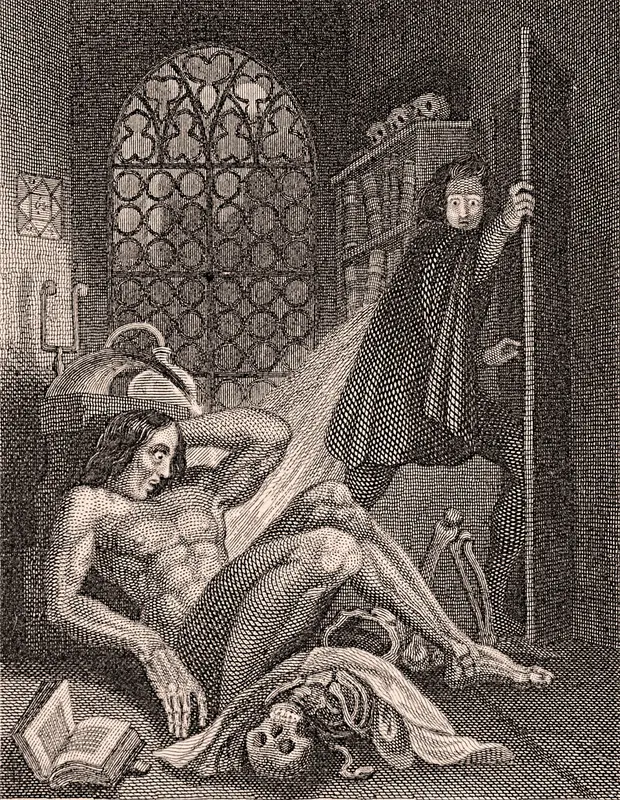
Frankenstein; or, The Modern Prometheus began in the summer of 1816, when Mary Shelley, Percy Shelley and Lord Byron were at Byron’s villa by Lake Geneva during what became known as the Year Without a Summer. Byron proposed that each of them write a ghost story. Mary was eighteen, and her story, which she expected to be short, grew into a novel at Percy’s urging. It was published anonymously on 1 January 1818, in three volumes and 500 copies. The creature is never given a name in the book, and the subtitle points to Prometheus, who gave fire to humans and paid for it.
The novel is told in frames: first the account of the explorer Robert Walton, then Victor’s story, and inside it the creature’s own account. Early reviews were mixed; Walter Scott praised its imagination, while John Wilson Croker called it “a tissue of horrible and disgusting absurdity” in the Quarterly Review. Success came fast anyway, through the stage: Presumption; or, the Fate of Frankenstein (1823) was performed 37 times in London. Many call it one of the first science-fiction novels, and Brian Aldiss argued it is the first true one. The 1831 one-volume edition, revised by Shelley with a new introduction, is the version most often read today.
Read it against the film. The lightning and the lurching come mostly from James Whale’s 1931 film, not from the book, where the creature speaks, reads and argues. In the book he is assembled from parts taken from charnel houses, graves and a slaughterhouse, and an early scene that matters is his first meeting with the person who made him. Watch who is telling the story to whom, and why; each narrator is making a case to be believed, and the reader is left to weigh them. The language is formal and the paragraphs long, so it rewards patience. The 1831 frontispiece by Theodor von Holst, shown here, depicts that moment.
Présentation rédigée pour LitMundi avec l’aide de l’IA et vérifiée d’après les sources ci-dessous.
La disponibilité des traductions reste à étudier. Un brouillon ne prouve pas l’absence d’une traduction.
← Retour à la collection