
Alice’s Adventures in Wonderland
English
Alice’s Adventures in Wonderland · English, Project Gutenberg #11
LireLewis Carroll · 1865
Une fillette qui s’ennuie suit un Lapin Blanc en gilet au fond d’un terrier, dans un monde qui réécrit sans cesse ses règles.
Alice, qui s’ennuie à côté de sa sœur, suit un Lapin Blanc muni d’une montre à gousset au fond d’un terrier et se retrouve parmi des créatures qui changent sa taille, mettent son nom en doute et se disputent en rond. Lewis Carroll, pseudonyme du mathématicien d’Oxford Charles Dodgson, l’a publié en 1865 avec les illustrations de John Tenniel.
Aucune traduction publiée dans la langue de cette interface. Vous pouvez lire l’original ou une autre édition disponible.
Lire · English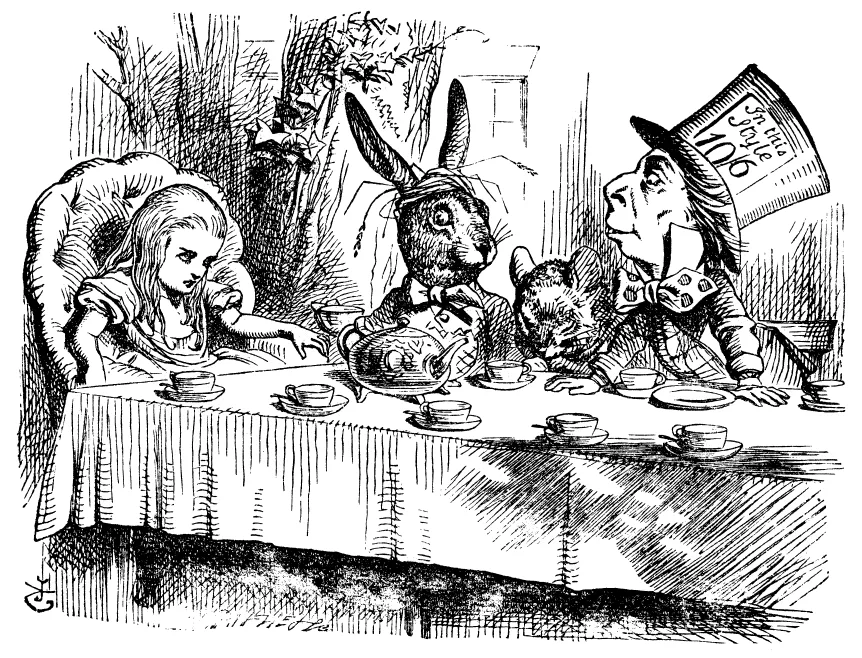
Alice’s Adventures in Wonderland is a short novel in which a bored girl follows a White Rabbit down a hole and meets creatures who change her size, question who she is and reason in circles. Wikipedia places it in the genre of literary nonsense, where logic is played with rather than abandoned, which helps explain why it has held adults as well as children. Lewis Carroll was the pen name of Charles Lutwidge Dodgson, an Oxford mathematician and Anglican deacon. The book has never been out of print and, according to Wikipedia, has been translated into 174 languages. Readers keep returning because almost every scene is a small puzzle about words, rules and manners, told in a calm, matter-of-fact voice.
The story began on 4 July 1862, when Carroll rowed up the Isis from Oxford with the three young daughters of Henry Liddell, the Dean of Christ Church, and told them a tale. He wrote it out as Alice’s Adventures Under Ground and gave Alice Liddell the manuscript on 26 November 1864. The published book is about twice as long and adds episodes such as the Mad Hatter’s tea party. Macmillan issued it in London in 1865, with 42 wood-engraved illustrations by John Tenniel. The first print run was withdrawn because Tenniel objected to the printing quality, and the reprint appeared in November 1865. Wikipedia credits the book with helping end an era of didactic children’s writing, in favour of writing meant to “delight or entertain”.
While reading, watch the language. Puns, parodies and literal-minded answers drive the humour, and Alice’s repeated attempts to remember who she is give the comedy an unsettling edge. Notice the pictures too: Carroll’s text is light on description, so Tenniel invented his own characters, and they have been part of the book ever since. Wikipedia reports that Carroll appears in the story as the Dodo. The book had a long afterlife. Carroll published a sequel, Through the Looking-Glass, in 1871; a London stage musical followed in 1886; a 1903 British silent film is described as the first screen adaptation; and John Lennon attributed the imagery of “Lucy in the Sky with Diamonds” to his reading of Carroll.
Présentation rédigée pour LitMundi avec l’aide de l’IA et vérifiée d’après les sources ci-dessous.
La disponibilité des traductions reste à étudier. Un brouillon ne prouve pas l’absence d’une traduction.
← Retour à la collection