
The Time Machine
English
The Time Machine · English, Project Gutenberg #35
ReadH. G. Wells · 1895
A Victorian inventor builds a machine that travels through time, and returns with news of the year 802,701.
A man known only as the Time Traveller tells his dinner guests that time is a fourth dimension, and later comes back with a story to prove it. He has ridden a machine of his own making into the far future, where he meets two very different peoples and has to decide what they are. H. G. Wells’s 1895 novella gave the world its phrase “time machine”.
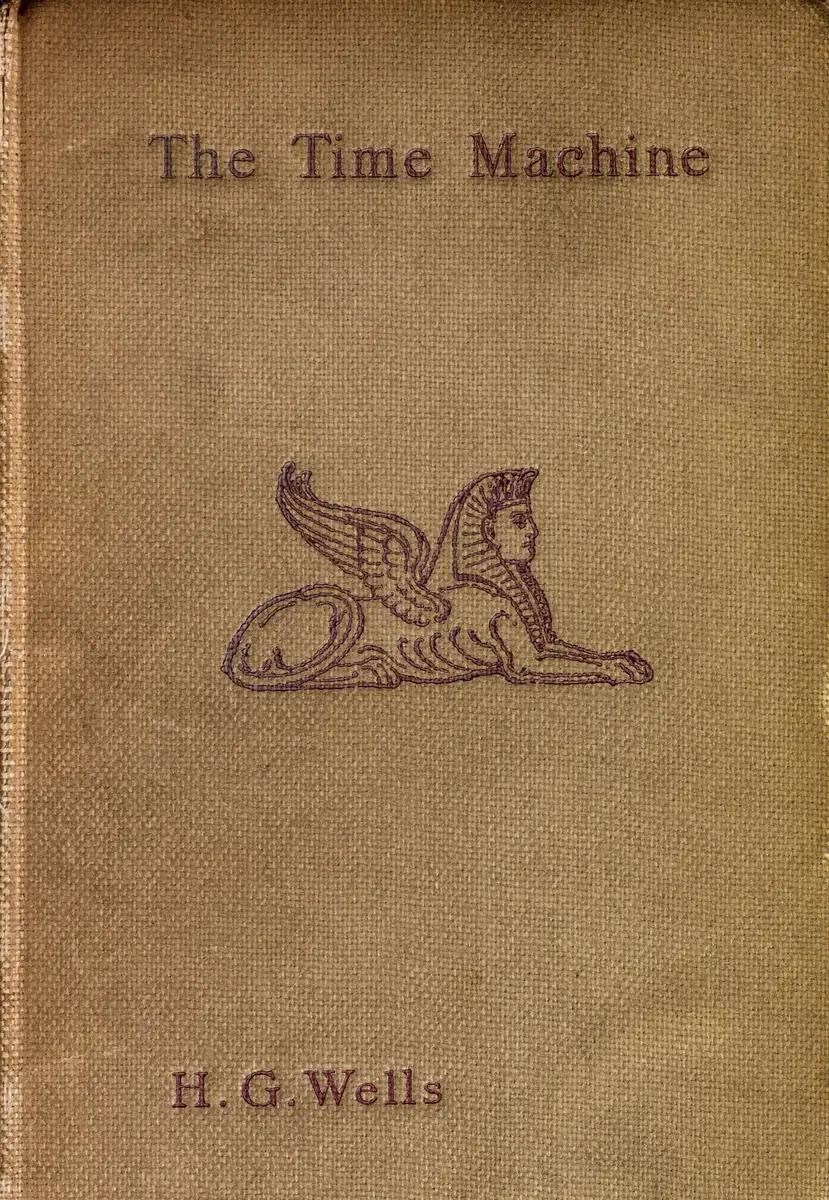
The Time Machine is short, fast and strangely calm. A gentleman inventor sits in a lamplit room and describes, without panic, what he found in the year AD 802,701. It still reads as alive because Wells wastes no time on gadgetry. The machine is a vehicle for a question: what happens to people when their conditions of life are pulled far enough apart? The answer he imagines is unsettling in the way a good argument is, and it keeps the book on syllabi and reading lists well beyond the age of the genre it helped start.
Wells began with a story called The Chronic Argonauts (1888) in his college paper, rewrote it as seven essays in the National Observer in 1894, then as a serial in the New Review from January to May 1895, for which he was paid £100. Holt published the first book edition in the US on 7 May 1895, and Heinemann followed in Britain on 29 May. Wells coined the term “time machine”, and the book is credited with making time travel a deliberate, controllable act. It is also an early example of the dying-Earth story. The 1960 film by George Pal and a 2002 remake followed.
Watch the two peoples the Traveller meets, the Eloi and the Morlocks, and how his explanation of them changes as he learns more; Wells presents them as descendants of the upper and lower classes, and the book is often read as a comment on class inequality. Wells had studied biology under T. H. Huxley and joined the socialist Fabian Society, and both show in the book’s thinking. The ending is open-ended; read the last pages slowly and note what the narrator does and does not claim.
Introduction written for LitMundi with AI assistance and checked against the sources listed below.
Translation availability is still being researched. A draft is not evidence that no translation exists.
← Back to collection