
Вишнёвый сад
Русский
Вишнёвый сад · Russian, Wikisource (Chekhov, 1903–1904 text)
ReadAnton Chekhov · 1904
A bankrupt Russian estate goes to auction, and its family spends the last days in denial, small schemes and long talk.
The Cherry Orchard (Вишнёвый сад) is Anton Chekhov’s last play, written in 1903 and first staged by the Moscow Art Theatre on 17 January 1904, under Konstantin Stanislavski. In four acts it follows Lyubov Ranevskaya, a landowner back from Paris, and her family and neighbours as the estate and its famous orchard are put up for sale to pay debts. Chekhov called it a comedy, but Stanislavski’s production treated it as a tragedy, and directors have been working with that split ever since.
No translation is published in this interface language yet. You can read the original or another available edition.
Read · Русский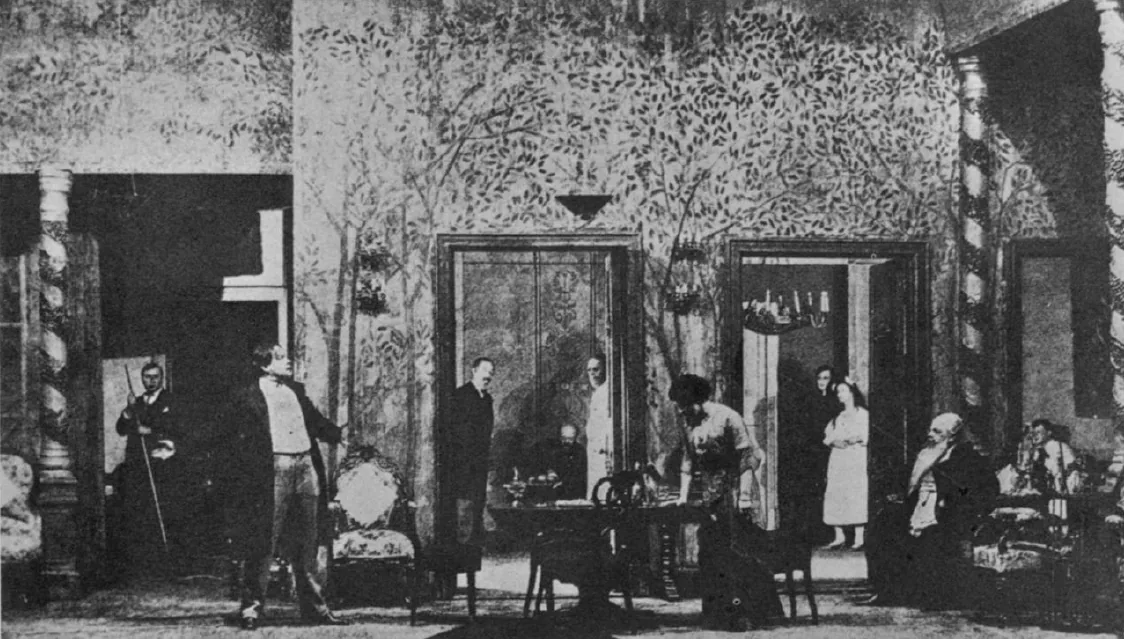
The Cherry Orchard is Anton Chekhov’s last play, a work Chekhov called a comedy though it ends in loss. Lyubov Ranevskaya, a landowner who has been living in Paris, comes home to an estate mortgaged and about to be auctioned. Her brother, her adopted daughter, a merchant whose father was a peasant and whose grandfather was a serf, and an old servant circle the problem without solving it. The play still feels alive because it keeps laughter and grief in view at once: the characters are funny, self-deceiving and sometimes cruel, and the audience is asked to feel both reactions in the same scene.
In its quiet way the method was new. In his four major plays, as Wikipedia summarises it, Chekhov offered a theatre of mood and a submerged life in the text in place of conventional action. The first production opened at the Moscow Art Theatre on 17 January 1904, under Stanislavski, who reshaped the second act into a tragedy against Chekhov’s wishes. Chekhov, already in worsening health, left for Germany soon after and died there in July that year. The article names playwrights influenced by the play, among them Eugene O’Neill, George Bernard Shaw, David Mamet and Arthur Miller, and directors who have staged it, including Peter Brook and Giorgio Strehler.
Notice the orchard itself. In the fourth act Lopakhin’s workers start cutting it down while the family is still in the house, and Anya reprimands him for it; the family leaves to the sound of the orchard being cut down. Chekhov had seen a version of this bargain at home. When his father’s family was ruined, a man named Selivanov bailed them out for the price of their house, and the Chekhov article compares him to Lopakhin in the play. Notice too that Lopakhin is given both pride and shame about where he came from, so no one in the play is simply a villain.
Introduction written for LitMundi with AI assistance and checked against the sources listed below.
Translation availability is still being researched. A draft is not evidence that no translation exists.
← Back to collection