
Dantons Tod
Deutsch
Dantons Tod · German, Project Gutenberg #5072
ReadGeorg Büchner · 1835
In spring 1794 Paris, the Revolution’s most famous orator is tired and doubtful, and the men who run the Terror are closing in.
Dantons Tod (Danton’s Death) is a four-act drama by Georg Büchner, written in about five weeks in early 1835 and first staged in Berlin in 1902. It follows Georges Danton and his circle in the last days of March and early April 1794, when Robespierre and his allies turn against them. Büchner builds the scenes from historical sources and long passages of real political speeches, so the characters talk as much as they act.
No translation is published in this interface language yet. You can read the original or another available edition.
Read · Deutsch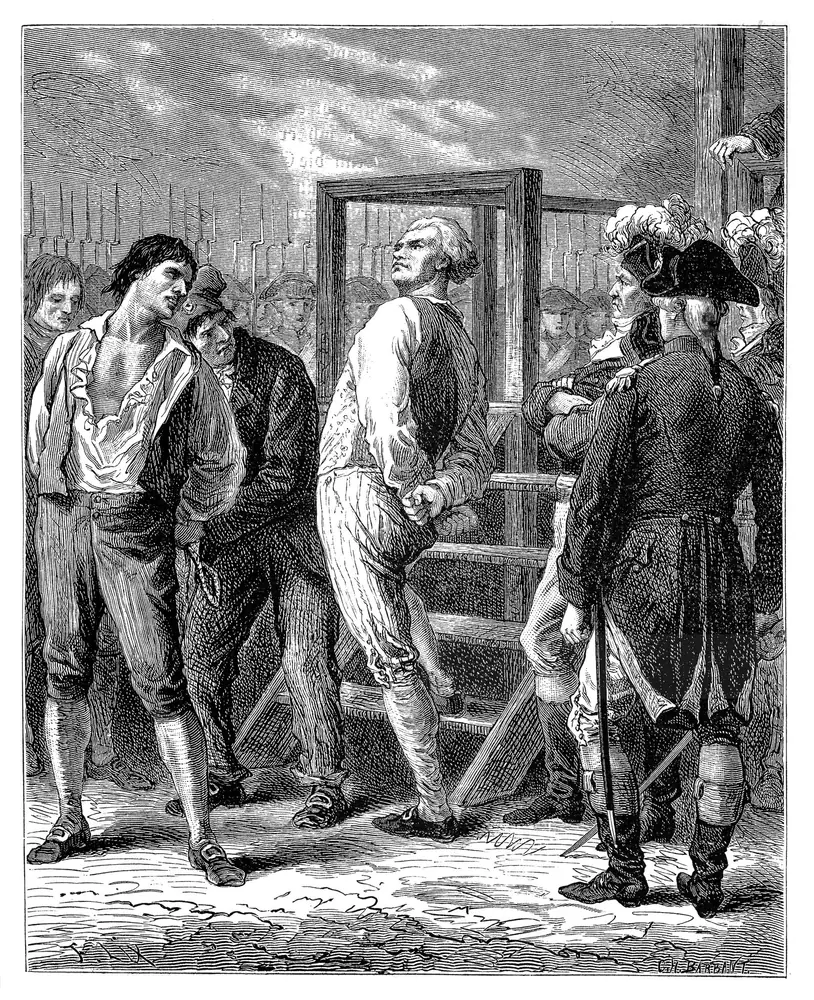
Dantons Tod is a four-act drama and Georg Büchner’s first play, set in Paris in the spring of 1794, during the lull between the first and second terrors. Georges Danton, who according to Wikipedia created the Revolutionary Tribunal, now wants the killing to stop, but he is tired, fond of wine and gaming, and doubtful about his own cause. Robespierre’s allies move against him and his friends. In the Conciergerie the prisoners argue about God, life and death as often as they plot. The play still feels alive because it shows a revolution as a machine that devours its own makers, and it gives ordinary people lines of their own, not only the orators.
Büchner’s method was new. He drew on many historical sources and quoted real political speeches at length, and in the twentieth century the play was read as a forerunner of documentary theatre, according to Wikipedia. He wrote the first full version in five weeks, from mid-January to mid-February 1835, while he feared arrest. That year a version appeared in Eduard Duller’s Phönix literary paper, edited by Karl Gutzkow, and a book edition carried a subtitle Duller invented to soothe the censor. The printed text was heavily cut. It is the only Büchner play published in his lifetime. No theatre dared stage it for decades; the first performance came on 5 January 1902 at the Belle-Alliance-Theater in Berlin.
Notice how often the scenes slide into talk: the prisoners debate God and death in the third act, a drunken citizen in the first act complains that his daughter must sell herself to feed the family, and Danton swings between resignation and the belief that the Convention will not dare act against him. Notice too that Robespierre is shown with a social conscience as well as a readiness to kill. Büchner’s own programme appears in a letter of 28 July 1835, quoted by German Wikipedia: the dramatist’s highest task is to come as close as possible to history as it really happened. This page uses a nineteenth-century engraving of an execution scene, not a stage picture from the play.
Introduction written for LitMundi with AI assistance and checked against the sources listed below.
Translation availability is still being researched. A draft is not evidence that no translation exists.
← Back to collection