
El encaje roto
Español
El encaje roto · original Spanish, Administración [1898?]
LireEmilia Pardo Bazán · 1897
Un mariage mondain de nuit, un évêque à l’autel, et un mot de la mariée que personne dans la salle n’avait vu venir.
Un narrateur est invité au somptueux mariage de Micaelita Aránguiz, et ce qui se passe à l’autel fait parler toute la ville. Des années plus tard, dans une station thermale, la mariée donne sa version. Pardo Bazán fait d’un scandale une étude discrète de ce qu’on attend d’une femme qu’elle avale.
Aucune traduction publiée dans la langue de cette interface. Vous pouvez lire l’original ou une autre édition disponible.
Lire · Español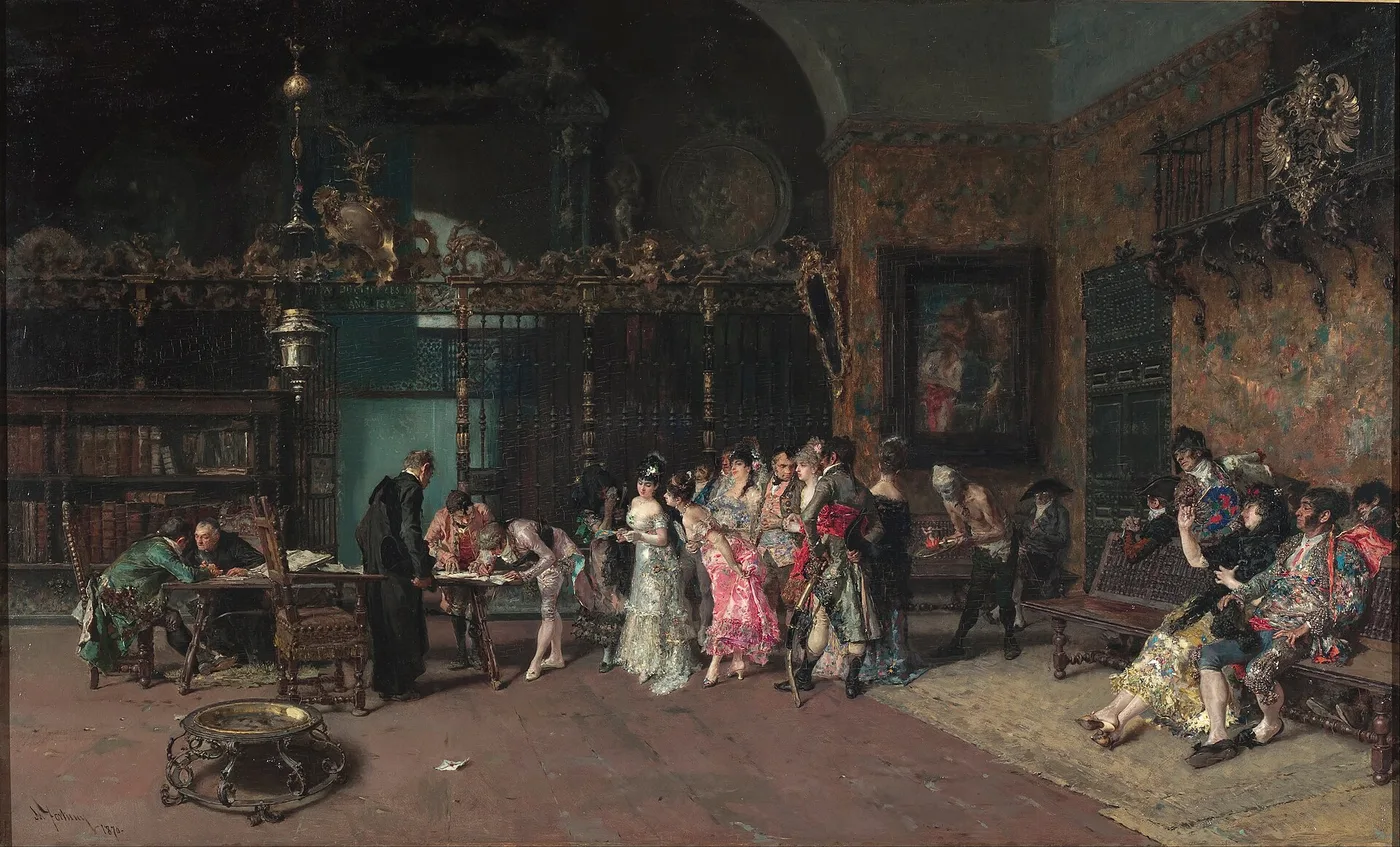
“El encaje roto” starts as gossip and ends as something harder to dismiss. The ceremony is a performance of correctness, with flowers, jewels and a bishop, and the story is about the gap between that performance and what the people inside it actually feel. Because the narrator is a guest and not a participant, the reader gets the rumours first and the reasons last, which is how scandals reach most of us. The pleasure is in seeing how the mystery gets deflated: the public hunts for a complicated explanation, and the truth turns out to be small, concrete and ordinary.
Emilia Pardo Bazán (1851–1921) was the leading Spanish naturalist, the author of La tribuna (1883) and Los pazos de Ulloa (1886), and her essay La cuestión palpitante (1884) defended naturalism against its critics. She wrote more than 600 short stories. This one appeared in the Madrid newspaper El Liberal on 19 September 1897, a realist story that fit in a newspaper but was written by someone who spent her career pressing for women’s education and rights. She was barred from the Royal Spanish Academy because of her sex, which colours how a story about a woman’s refusal reads.
Notice who gets to speak. The bride’s own account comes late, in a different place and a different mood, after everyone else has had their say. Watch how the narrator describes things, the lights, the dresses, the gestures, and how the lavish detail is a kind of pressure in itself. Then see how little the explanation needs to make the earlier speculation look foolish. The title is a clue, not a decoration; keep it in mind as you read, and see at which moment it starts to make sense.
Présentation rédigée pour LitMundi avec l’aide de l’IA et vérifiée d’après les sources ci-dessous.
La disponibilité des traductions reste à étudier. Un brouillon ne prouve pas l’absence d’une traduction.
← Retour à la collection