
Bartleby, the Scrivener: A Story of Wall-Street
English
Bartleby, the Scrivener · English, Project Gutenberg #11231
ReadHerman Melville · 1853
A Wall Street lawyer hires a copyist who meets every request with one polite sentence, and slowly loses control of his own office.
An elderly Wall Street lawyer, who narrates, takes on a new scrivener named Bartleby. At first Bartleby copies documents tirelessly; then he begins to answer requests with “I would prefer not to”. Published anonymously in two instalments in Putnam’s Monthly Magazine in 1853, it is a comedy of office manners that turns into something harder to name.
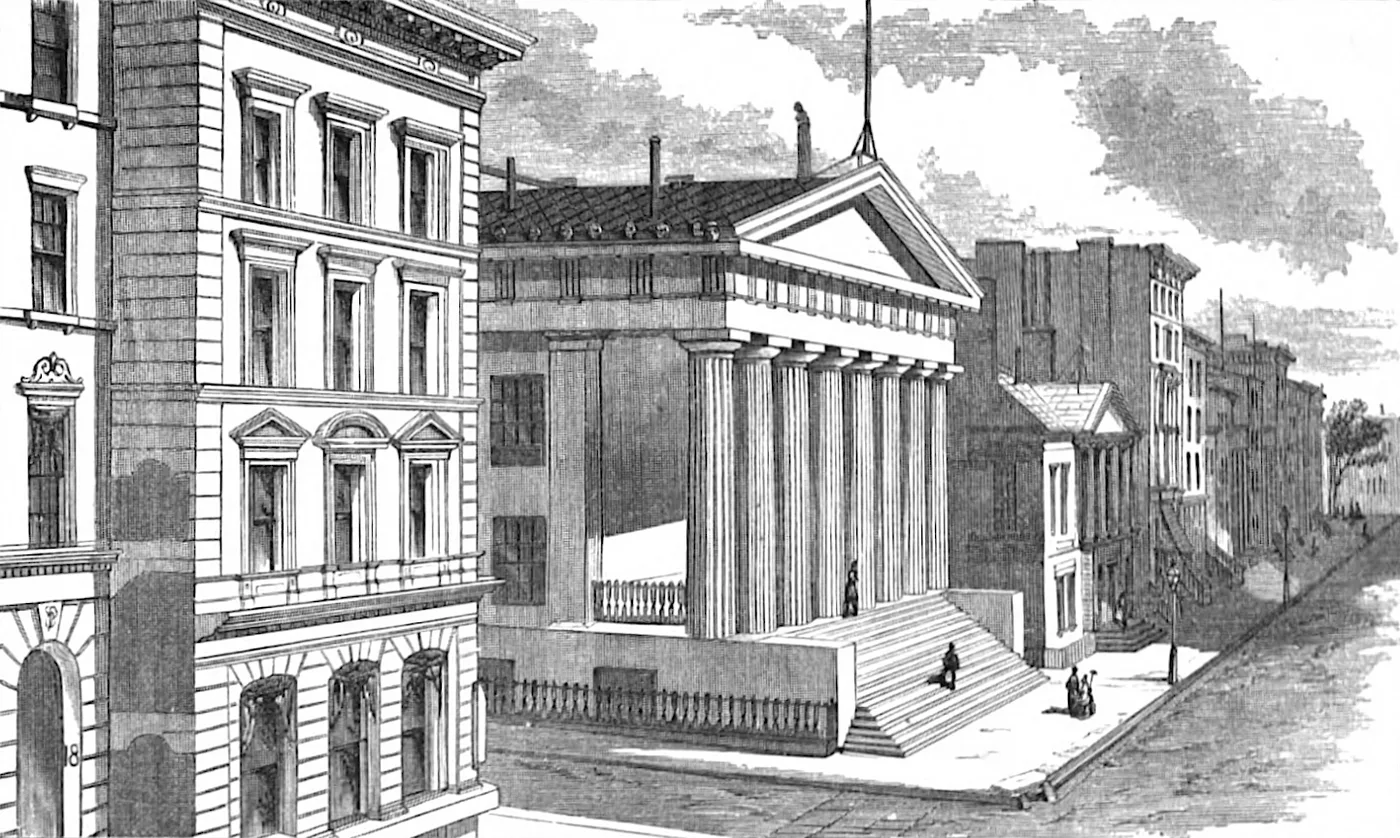
Bartleby, the Scrivener is a short story, about 45 pages, told by a lawyer who describes himself as a safe man in a comfortable profession. His office on Wall Street holds two copyists, an errand boy and, soon, a quiet new hire who will not do what he is asked and will not leave. It still feels current because every workplace knows the problem: how an institution, and the decent people inside it, respond to someone who refuses without raging. Critics have read Bartleby as depression, as the narrator’s double, as a portrait of Melville’s own disillusion, as a test of free will.
Melville published it anonymously in Putnam’s in November and December 1853. By then Moby-Dick (1851) had not found an audience and Pierre (1852) had been badly received, and he was turning to short magazine fiction. The story reappeared in The Piazza Tales in 1856. It was not a great success at the time; the Melville scholar Robert Milder later called it “unquestionably the masterpiece of the short fiction”. Its refusal formula has been argued over by philosophers, including Gilles Deleuze in Bartleby, ou la formule and Giorgio Agamben, and it echoes in Enrique Vila-Matas’s novel Bartleby & Co. It has also been adapted as a 1961 opera and as films in 1970, 1976 and 2001.
Read it as a story about the narrator as much as about Bartleby. He admits his own preferences, mocks his other clerks with affection, and meets each new refusal with a different, very human response: reason, bribery, charity, irritation, curiosity. Watch how his kindness and his self-interest keep trading places. Notice how little he can actually find out about the man he is employing. The tone starts near comedy and ends quietly sombre, and the final exclamation lands harder if you have followed that slow change.
Introduction written for LitMundi with AI assistance and checked against the sources listed below.
Translation availability is still being researched. A draft is not evidence that no translation exists.
← Back to collection