
Silas Marner
English
Silas Marner · English, Project Gutenberg #550
ReadGeorge Eliot · 1861
A weaver driven out of his chapel hoards gold in a Midlands cottage, until the gold goes and something else arrives.
Silas Marner, a linen weaver falsely accused in his northern chapel, settles in the village of Raveloe and shuts out everyone but his loom and his coins. George Eliot’s short novel of 1861 follows what a village, a landowner’s family with a secret, and one winter night do to that solitude.
Silas Marner is George Eliot’s third novel, published on 2 April 1861, and its premise reads like a folktale: a lonely weaver, a hoard of gold, a loss, a child. Eliot sets it in realist detail in the early nineteenth century, with the Lantern Yard congregation, the loom, the talk at the Rainbow Inn in Raveloe, so the fable has to survive contact with money, class and village opinion. It reads as alive because its question is plain: what does a person need in order to belong to a community, and what becomes of someone who has been shut out of one?
Critics have read it as realism carrying myth and legend, as a study of alienation, and through the ideas of Wordsworth. Its double plot sets Silas beside the squire’s son Godfrey Cass, whose secret life one critic calls “both parallel and foil” to Silas’s. The central situation, a child arriving in a miser’s life, was borrowed openly by W. S. Gilbert for his play Dan’l Druce, Blacksmith (1876). The novel travelled: Premchand wrote a Hindi adaptation called Sukhdas, a 1954 Telugu film, Bangaru Papa, is loosely based on it, and Steve Martin’s 1994 film A Simple Twist of Fate retells it.
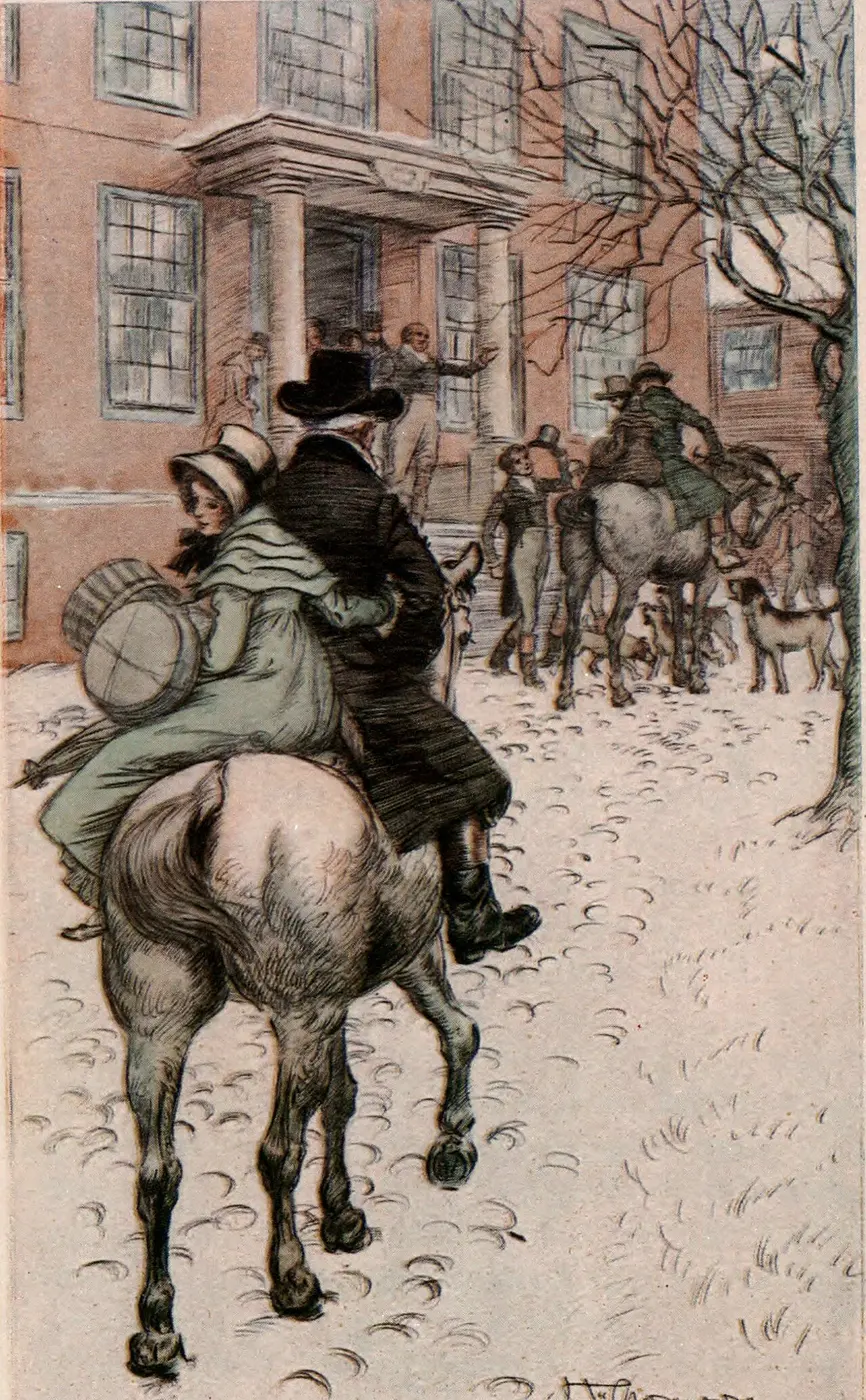
While reading, listen to the village. Eliot gives the Raveloe gossips their own comedy and their own kindness, and the neighbour Dolly Winthrop’s practical help counts for as much as any sermon. Compare the cold, careful order of Silas’s cottage with the loose, money-troubled household of the Casses, and notice how the book treats chance, luck and responsibility as different things. The picture here is a coloured plate by Hugh Thomson from Macmillan’s 1907 edition: Nancy Lammeter arriving at the Red House, as chapter 11 describes.
Introduction written for LitMundi with AI assistance and checked against the sources listed below.
Translation availability is still being researched. A draft is not evidence that no translation exists.
← Back to collection