
The Red Badge of Courage
English
The Red Badge of Courage · English, Project Gutenberg #73
ReadStephen Crane · 1895
A frightened young private waits for his first battle, and Crane, who had never seen one, puts us inside his head.
Henry Fleming, called “the youth,” is a Union private who has dreamed of glory and now waits for his regiment’s first battle, unsure how he will behave when it comes. Crane follows him in close third person through noise, smoke, rumour and the talk of the men around him. Stephen Crane wrote it in 1893–94, before he had ever been in combat, and Appleton published it in New York in 1895.
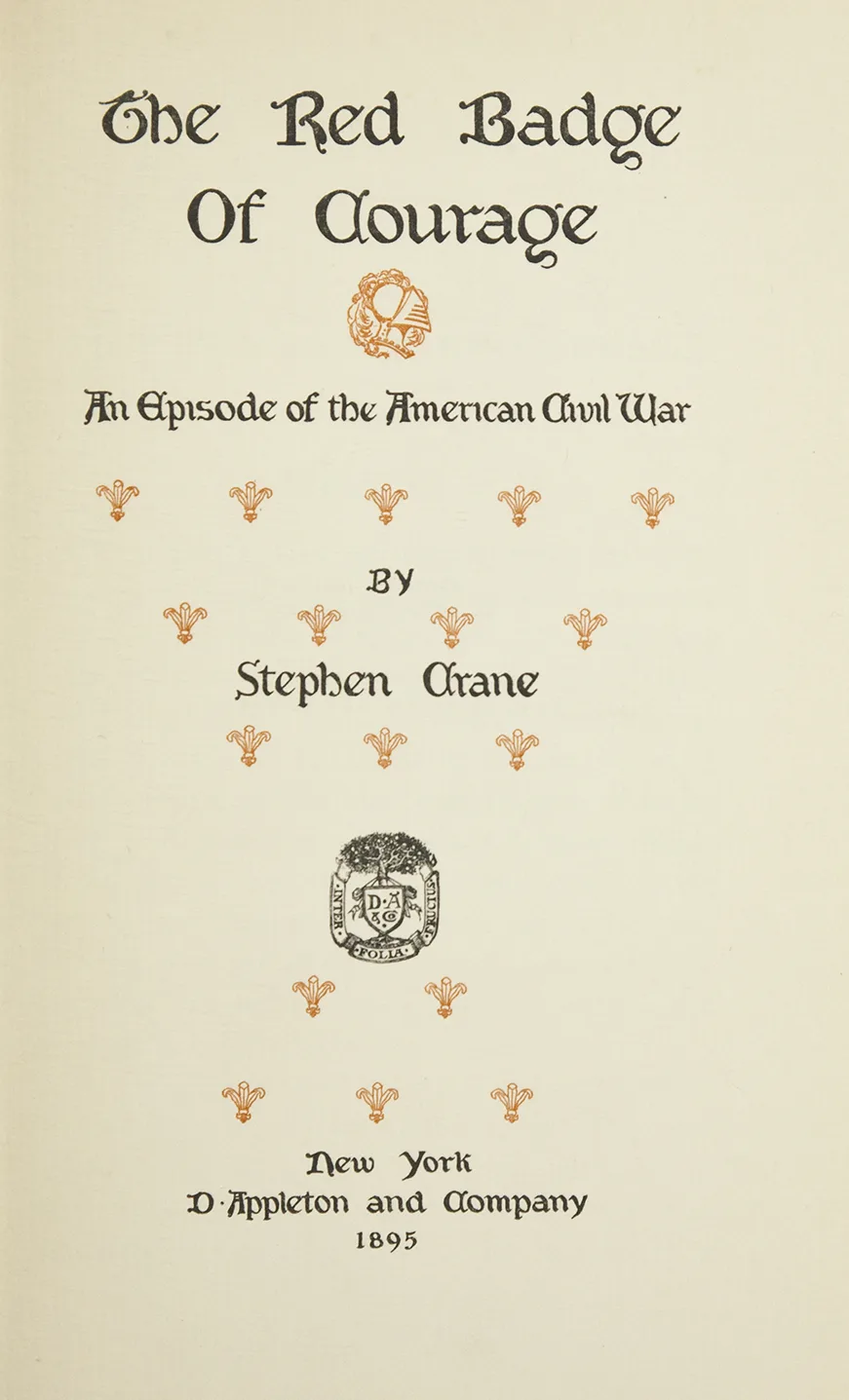
The Red Badge of Courage follows one nervous private, called “the youth,” through a Civil War battle, and it is short enough to read in a sitting. Crane stays inside what a single mind notices: noise, smoke, rumour, the faces of men nearby. He had never been in a battle when he wrote it; he put it plainly, “Of course, I have never been in a battle.” That makes the book’s nerves more striking. Henry Fleming’s wish to be brave, and his dread that he is not, are not period details. Anyone who has waited for an exam, a fight or a verdict will recognise them, whatever the uniform.
Crane began writing in June 1893 and finished in April 1894. In December 1894 a version cut to about 18,000 words ran in the Philadelphia Press and was reprinted in newspapers across the country; Appleton brought out the book in 1895, in a text about 5,000 words shorter than Crane’s manuscript. It sold well, reaching ten editions in its first year, and Joseph Conrad wrote that it “detonated” with great force in Britain. The method was new: third-person limited point of view, colour imagery repeated like a refrain, irony in place of heroics. In 1942 Hemingway called it “one of the finest books of our literature.”
Notice how often Crane reaches for colour, and how the same sky, field or flag looks different as Henry’s mood shifts. Notice the gap between what he feels and what he lets others think, and how quickly his opinion of himself turns over. Notice, too, that the war is seen from the ranks: nobody explains the strategy, and the men know little more than the reader does. Readers have long proposed Chancellorsville as the battle behind the book, but the story works without a name. Go in without expecting a tidy lesson; the book is more interested in how a young man sees himself.
Introduction written for LitMundi with AI assistance and checked against the sources listed below.
Translation availability is still being researched. A draft is not evidence that no translation exists.
← Back to collection