
Den lille Pige med Svovlstikkerne
Dansk
Den lille Pige med Svovlstikkerne · Dansk, Eventyr II (Det Nordiske Forlag 1900)
ReadHans Christian Andersen · 1845
On New Year’s Eve a poor child tries to sell matches in the snow, and each one she lights shows her something she wants.
A girl who has sold no matches on a freezing New Year’s Eve dares not go home, because her father would beat her. She strikes the matches one by one for warmth. Hans Christian Andersen’s few pages are among the best-known fairy tales ever printed.
No translation is published in this interface language yet. You can read the original or another available edition.
Read · Dansk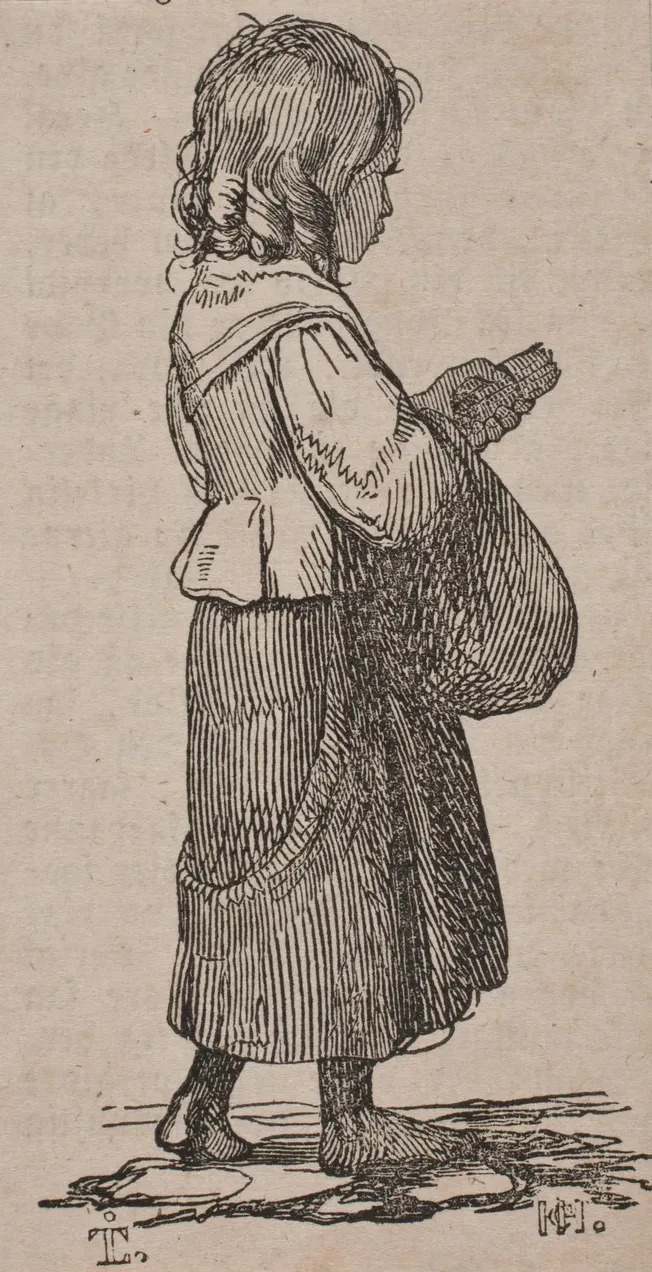
Andersen’s “The Little Match Girl” is only a few pages long and has been adapted for films, television, opera and concert hall. It still reads as alive because the cold in it is not magic. It is New Year’s Eve, the girl is afraid to go home, and what she sees in the glow of her matches is exactly what a hungry, freezing child would want: an iron stove, a roast goose, a family at table, a Christmas tree. Poverty and neglect are described plainly, with no villain beyond indifference, and the story is built on the contrast between the lit windows and the dark street outside.
It first appeared in December 1845 in Dansk Folkekalender for 1846, a Danish almanac, and was later collected in New Fairy Tales (1848) and Fairy Tales (1850). The Danish Wikipedia article says the almanac’s editor sent Andersen illustrations and asked him to write stories to go with them, and that a woodcut after the painter Johan Thomas Lundbye, showing a poor child selling matches, may have been one source of inspiration. The tale has since been retold often: Jean Renoir directed a silent film in 1928, Helmut Lachenmann wrote the opera Das Mädchen mit den Schwefelhölzern, and David Lang’s The Little Match Girl Passion won the 2008 Pulitzer Prize in music.
Read for the way Andersen controls a very small story. The pattern repeats, a match struck, a vision, darkness, and each vision is warmer than the last. Notice who appears among the final matches: the grandmother, whom the story calls the only person who had ever treated the girl with kindness. Notice, too, that the ending is not softened, and that the narrator’s tone stays gentle while it tells you what has happened. Readers disagree about whether the close is consoling or bleak, and the story gives you room to decide. Terry Pratchett’s Hogfather (1996) borrows the tale and gives it a happier turn.
Introduction written for LitMundi with AI assistance and checked against the sources listed below.
Translation availability is still being researched. A draft is not evidence that no translation exists.
← Back to collection