
The Tell-Tale Heart
English
The Tell-Tale Heart · English, The Works of Edgar Allan Poe, Raven Edition, vol. 2
ReadEdgar Allan Poe · 1843
A narrator swears he is not mad, then tells you exactly how carefully he got rid of an old man’s eye.
The narrator insists he is calm, and perfectly sane, and he proves it by describing a murder in exact detail. The old man’s pale blue eye is the cause; a sound that will not stop is the consequence. Poe packs it into a few pages that read aloud like a confession.
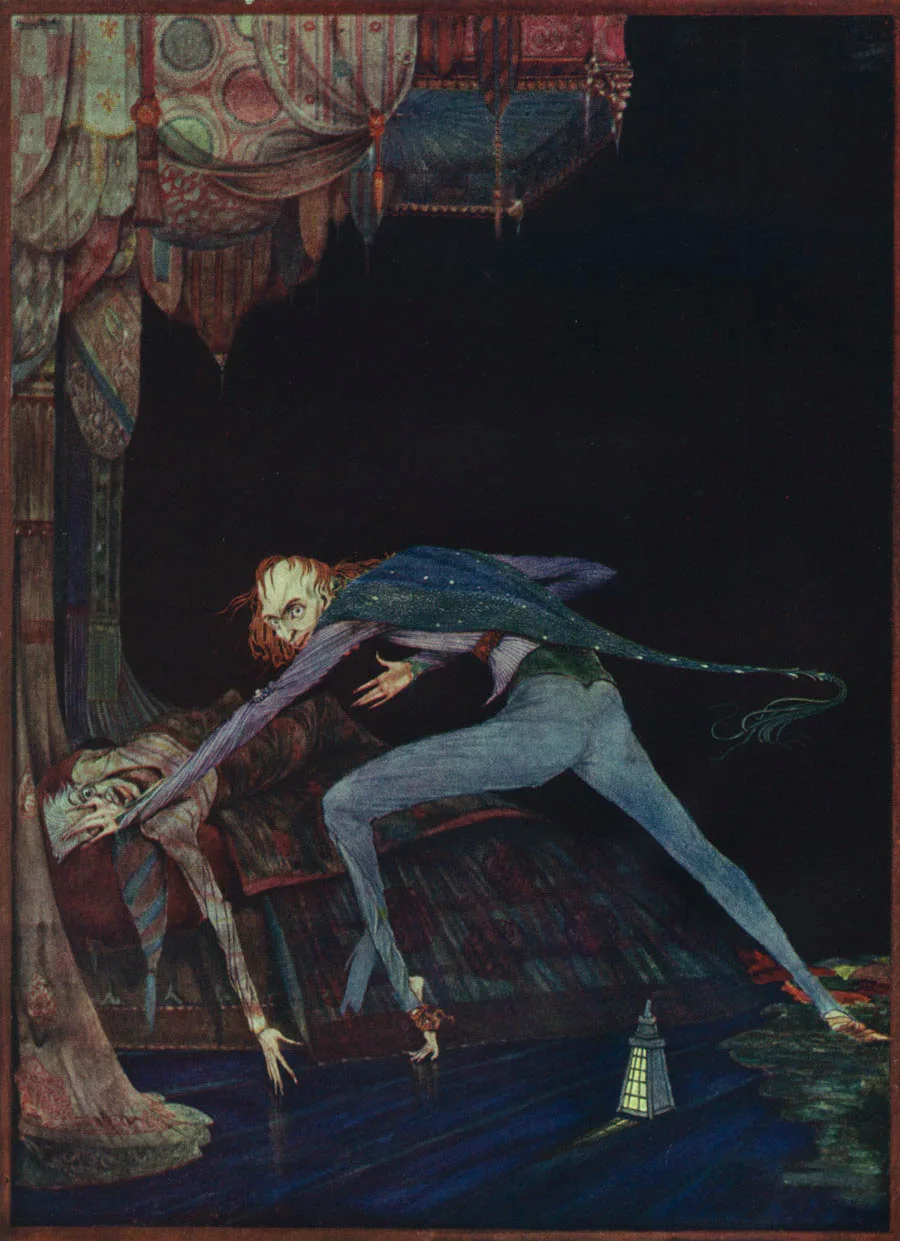
The Tell-Tale Heart is a first-person confession of a murder from a narrator who insists that he is not mad. That insistence is the engine: the more calmly he describes his planning, the more clearly the reader sees the opposite. The story has no name for him, no motive beyond an old man’s pale blue, vulture-like eye, and no setting beyond a house and its floorboards. A few pages are enough because the voice never relaxes. It reads as alive today because it works on a reader’s ear: the sentences speed up, repeat and break, and you are asked to judge sanity from the rhythm of a sentence.
Poe published it in January 1843, in the first issue of The Pioneer, a short-lived Boston magazine edited by James Russell Lowell and Robert Carter. It is a classic of Gothic fiction and one of his best-known stories, and a standard example of the unreliable narrator. Critics have read the old man as a father figure, a landlord or an employer; Richard Wilbur argued that it is an allegory of imagination against science, and others have wondered whether the sound is deathwatch beetles or the narrator’s own pulse. The earliest acknowledged screen adaptation is a 1928 American silent film, and a 1953 animated short by UPA is preserved in the U.S. National Film Registry. Poe is also generally regarded as a pioneer of detective fiction, with his Dupin tales.
While reading, watch the verbs of time and the claims of calm: the narrator keeps telling you how slowly, how wisely he proceeded. Notice that nothing outside his account is confirmed, so the story cannot be fully trusted, and that the title promises a heart which gives away something. The narrator has no stated gender, and some critics have argued that he might be a woman, so keep that possibility open. Read it aloud once. It is short enough to do so in under half an hour, and the effect is different when you hear it. A content note: it contains a murder and dismemberment, described briefly.
Introduction written for LitMundi with AI assistance and checked against the sources listed below.
Translation availability is still being researched. A draft is not evidence that no translation exists.
← Back to collection