
阿Q正傳
中文
阿Q正傳 · 中文, 《魯迅全集》第一卷(1938;1948 年重印)
ReadLu Xun · 1921
A penniless village drifter turns every beating into a private victory, in the novella that gave Chinese a word for self-deception.
Ah Q is a hired hand with no family, no land and no certain name, living in the village of Weizhuang around the time of the 1911 revolution. Lu Xun’s narrator plays the dutiful biographer while the story laughs, then stops laughing. It is short, quick to read, and sharper than its reputation as a school text suggests.
No translation is published in this interface language yet. You can read the original or another available edition.
Read · 中文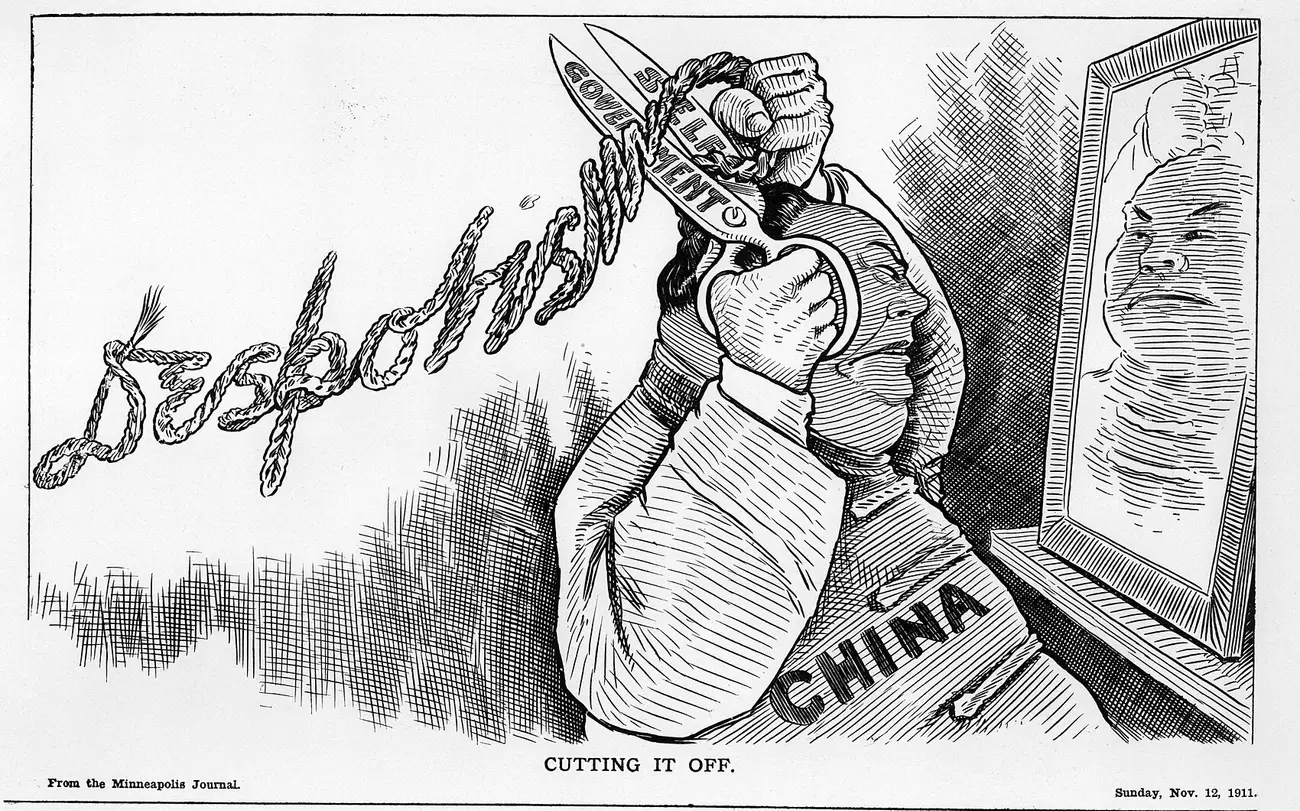
The True Story of Ah Q follows a farmhand in the village of Weizhuang, around the time of the 1911 Revolution. He has no family, no land and no fixed work, and the narrator admits at the outset that he cannot even verify the man’s name. Ah Q bullies anyone weaker, cowers before anyone stronger, and turns each humiliation into what Lu Xun calls a spiritual victory. The phrase “Ah Q mentality” is still used in Chinese for someone who denies reality in order to feel superior, and the character is easy to recognise in any office, family or country that cannot admit it has lost.
It was written in vernacular Chinese, in the years after the May Fourth movement had made that choice a statement. It ran in instalments in the supplement of the Beijing Morning News from 4 December 1921 to 12 February 1922, under the pseudonym Ba Ren, roughly “crude fellow”, and few readers knew who the author was. It was then collected in Call to Arms (1923), where it is the longest piece. Critics argued over it at once: Zhou Zuoren read it as plain satire, while Mao Dun doubted it was only that and saw in Ah Q a crystallisation of national traits. Julia Lovell’s Penguin translation (2009) is titled The Real Story of Ah-Q.
Notice the narrator. He opens like a conscientious chronicler, fussing over Ah Q’s surname and birthplace, and that pedantry is the joke. Watch how small the “victories” are, and how the same habit of mind belongs to the village’s respectable people as well. When the revolution arrives, it comes to Weizhuang as rumour, new vocabulary and a change of costume rather than a change of heart. The comedy is steady for most of the nine chapters; the last ones are much darker, and the ending is best met without warning. Vietnamese readers know the book as AQ chính truyện, and the idea of “phương pháp thắng lợi tinh thần” needs no explaining.
Introduction written for LitMundi with AI assistance and checked against the sources listed below.
Translation availability is still being researched. A draft is not evidence that no translation exists.
← Back to collection