
Den lille Havfrue
Dansk
Den lille Havfrue · Danish, Wikisource transcription
ReadHans Christian Andersen · 1837
A young sea princess gives up her voice for legs that hurt with every step, for a prince who never learns what she has done.
The Little Mermaid (Den lille Havfrue, 1837) is a literary fairy tale by Hans Christian Andersen. A sea king’s youngest daughter, fascinated by the human world above the waves, saves a prince from a shipwreck and bargains with the sea witch for legs at the cost of her voice. She must win his love to gain an immortal soul, and the price of failing is that she will not live past dawn.
No translation is published in this interface language yet. You can read the original or another available edition.
Read · Dansk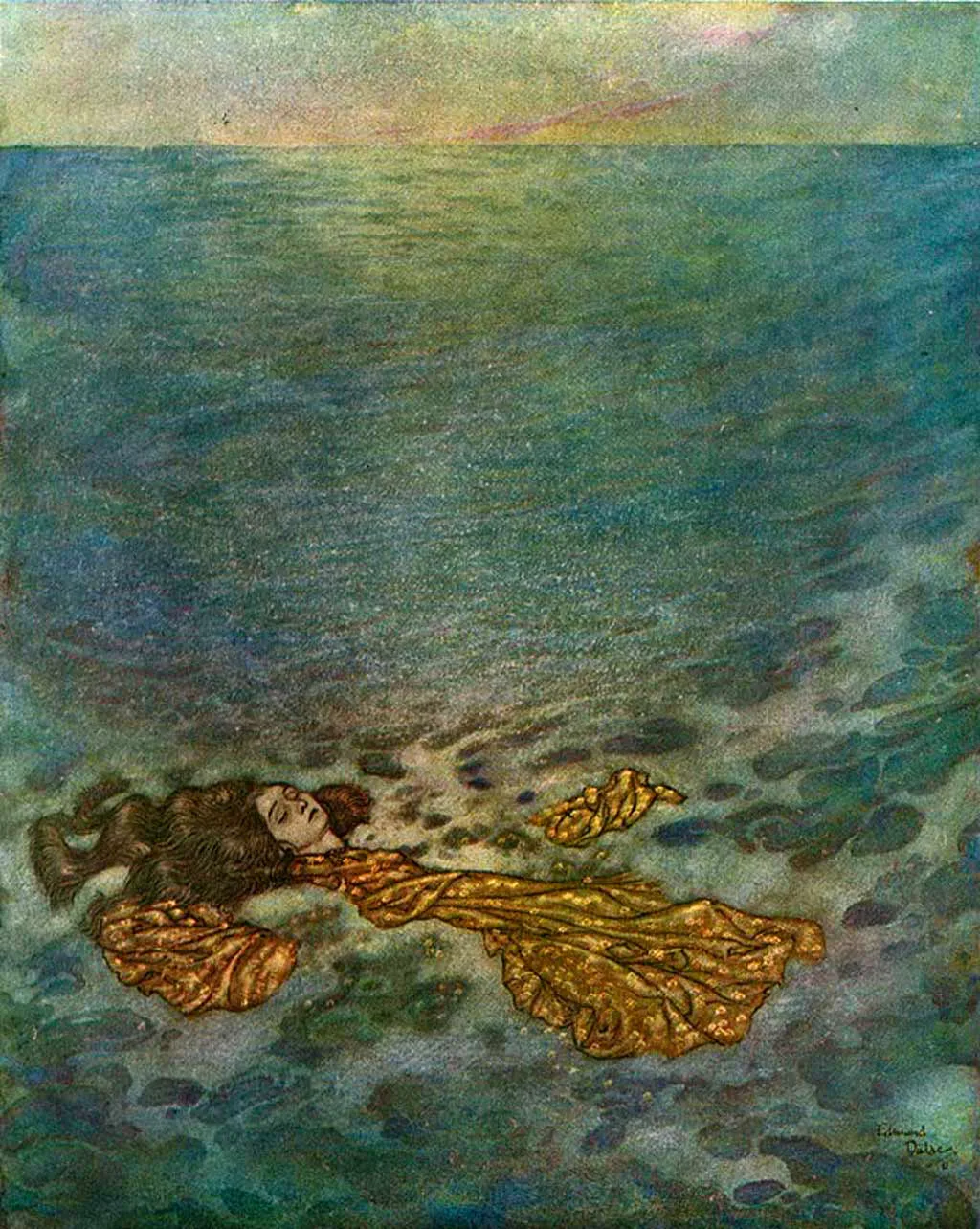
“The Little Mermaid” (Den lille Havfrue) was written by Hans Christian Andersen in 1836 and published by C. A. Reitzel in Copenhagen on 7 April 1837, in the first collection of fairy tales he told for children, nine tales in all. A young sea princess, allowed at fifteen to look at the world above the water, falls for a prince and trades her voice and her tail for legs, hoping to gain an immortal soul. It is still read because the bargain is so concrete and so lopsided: the sea witch warns that each step will feel like walking on sharp knives, and the one she loves never learns what she gave up.
The ending is Andersen’s own. According to Wikipedia, he wrote to a friend in 1837 that, unlike de la Motte Fouqué in Undine, he would not make the mermaid’s immortal soul depend on a human being’s love; he gave her a longer path instead, doing good deeds among the Daughters of the Air, which was also the story’s working title. Critics argue over whether that last turn consoles or contradicts the tragedy, and P. L. Travers objected to children being told that their behavior shortens or lengthens her wait. Andersen’s foreword admits the tale suits adults best, but he trusted children would enjoy it too.
Notice how little the prince knows: he believes the girl from the temple saved him, confides in the silent mermaid as a favorite companion, and never asks why she dances in pain. Maria Tatar reads the heroine less as a lover than as a curious explorer. Content note: she is told she will die at dawn if the prince marries another, her feet bleed with pain, and her sisters hand her a dagger; the ending is sad before it turns hopeful. Suitable for older children and adults. The Vietnamese text on this site is the site’s own translation made directly from the Danish.
Introduction written for LitMundi with AI assistance and checked against the sources listed below.
Translation availability is still being researched. A draft is not evidence that no translation exists.
← Back to collection